Great Depression
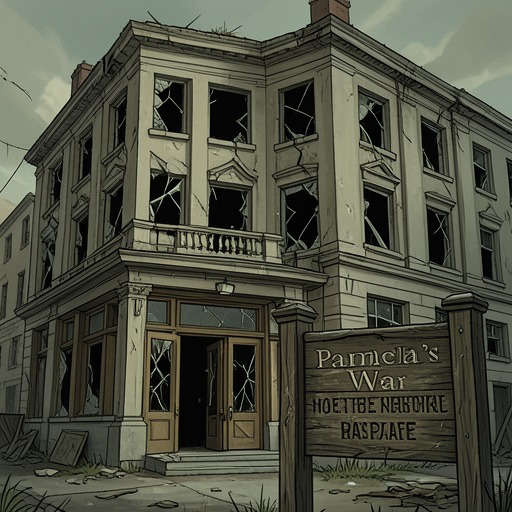
Pamela's WarThe Great Depression is the economic condition that frames the Wheeler family’s decision to build a new livelihood through The Woodman Hotel. In the book, its apparent ending produces a brief interval of commercial confidence: Pamela Wheeler Fellows’s parents believe that prosperity has returned, that the hotel can attract customers, and that their enterprise will make their fortune. That confidence matters because it establishes the hopeful world that later war, regulation, bereavement, and displacement will dismantle.
Recovery and Commercial Optimism
Pamela Wheeler Fellows presents the post-Depression moment as one in which optimism seems almost self-evident. Her parents are convinced that the hotel represents a great career move and ask how they can fail now that the Depression is over and everything appears to be going well. The question captures both their excitement and the blindness built into it: their plans are based on an economic recovery that feels secure, while the larger political future remains outside their imagination.
The hotel initially becomes a conspicuous centre of local prosperity. The car park fills with the era’s top-of-the-range vehicles when the local car club from Harborne gathers for a drink and conversation. Young men stand with beer, cigarettes, or pipes, absorbed in the open bonnets of the cars, and the hotel becomes the place to be seen. Downstairs, a chrome-and-mirror cocktail bar is installed; upstairs, a dining room with black, flame, and gold decoration, Lloyd Loom chairs, small round tables, and a central dance floor creates a deliberately modern social setting. Music rises from the Radiogram in the bar, while three open fireplaces make the rooms welcoming in winter. These details turn economic recovery into an interior style: prosperity is displayed through cars, cocktails, decoration, music, and sociability.
Prosperity Under Pressure
The Depression’s apparent conclusion does not protect the hotel from the conditions that follow. As the war advances, fewer customers can drive and very few live within walking distance, so the reduced clientele receives far more attention than before. The hotel’s rural position, once compatible with leisure and motoring, becomes a liability when transport is restricted and wartime scarcity narrows ordinary life. The establishment must increasingly survive through vigilance, adaptation, and the careful management of whoever can still reach it.
Its position opposite the police station adds another pressure. Strict licensing laws mean that selling alcohol outside permitted hours could lead to the removal of the licence and the permanent loss of the family’s livelihood. Pamela Wheeler Fellows can see over the top sash window of the police station from the elevated bar. When the Sergeant puts on his helmet, the staff receive the warning they need: they call time, cover the beer pulls with towels, lower the shutters, and persuade remaining customers to finish drinking before he crosses the road. The arrangement works for months, turning the hotel’s architecture into a device for evading the economic consequences of legal enforcement. The family’s survival now depends not on expansion but on observation, timing, and improvisation.
From Enterprise to Wartime Service
The hotel’s function changes further as the surrounding community is mobilised. A group of young local men trains as the Home Guard on the field behind the police station, where Pamela Wheeler Fellows once played cricket. Sidney Wheeler’s commands carry through the hotel’s open windows as he drills them into formation. Their lack of uniforms and weapons exposes the material weakness of the early defence effort: armbands replace proper clothing, broom handles stand in for rifles, and the men practise with whatever weapons might be available if a German parachutist had to be captured. Yet they patrol the Clent Hills at night, treating the protection of Clent and the surrounding area as a serious responsibility.
The hotel also becomes part of the practical economy of military support. A battalion of young soldiers stationed about half a mile away operates a searchlight against German bombers but cannot prepare an adequate meal from its basic rations and limited cooking experience. Marie Wheeler responds by offering to cook their meat at the hotel if they deliver it to the kitchen and return at the appointed hour. The resulting meals, served around a large table, are a direct contribution to the war effort, although the soldiers also drink at the licensed premises. The family business that began as a speculative response to economic recovery is thus absorbed into the labour of sustaining soldiers and civilians.
War’s Destruction of the Recovery Horizon
The political danger that Pamela Wheeler Fellows’s parents cannot yet imagine becomes an immediate force in their lives. The war reaches terrifying levels as battles are lost, London endures months of bombing, and Adolf Hitler turns his attacks toward provincial cities. When Coventry is bombed on 14 November 1940, the fires can be seen from forty miles away; the city burns under successive waves of bombers. Other historic cities, including Bath, Canterbury, York, Norwich, and Exeter, also suffer attacks intended to break morale by destroying both inhabitants and architectural heritage.
The family’s own movement shows how completely the economic and social landscape has changed. The Woodman Hotel, where Pamela Wheeler Fellows spent her adolescent years, is left behind when Sidney Wheeler secures a lease on a top-floor mansion flat about half a mile from Birmingham city centre. The property may have attracted little competition because bombing is increasing nightly. The family leaves the relative safety of the countryside for a city under attack, carrying suitcases into a future in which the commercial world of cars, cocktails, and dancing has been replaced by danger and deprivation.
The new flat provides no reliable security. During an air raid, the shelter is inaccessible and residents gather on the ground floor. Sidney Wheeler orders everyone onto the floor with their hands over their ears, drawing on his experience as an officer. When the bombing ends, shrapnel holes are found mostly at waist or head height; anyone who had remained standing could have been struck. The scene compresses the book’s reversal of fortune into a physical measurement. The family’s earlier confidence in a stable future has become a struggle to survive the next raid.
Economic Memory and Collective Endurance
The Great Depression is therefore remembered less as a self-contained historical episode than as the opening contrast for a world repeatedly reshaped by crisis. The family’s initial belief that prosperity has returned gives way to wartime shortages, restricted movement, loss, and the need to repurpose domestic and commercial spaces. Against that pressure, the book records a wartime spirit in which strangers speak like old friends, offer lifts, and help one another. Radio comedy, music for factory workers, and broadcasts intended to sustain morale likewise make endurance a collective practice.
The contrast reaches its sharpest point on VE-Day. Across the country, street parties fill the roads with trestle tables, bunting, Union Jacks, sandwiches, trifles, jelly, cake, fireworks, and bonfires. Hoarded food is brought out to create a feast despite rationing. Yet celebration is uneven: at John Fellows’s parents’ home, the family remains anxious because Rex Fellows has been missing for months, and a telegram addressed to his father threatens to convert victory into private grief. The Depression-era hope that material life could simply resume after hardship has been replaced by a more complicated knowledge. Recovery may produce decorated rooms and crowded car parks, but history can overturn them; endurance survives through vigilance, care, communal feeling, and the painful recognition that public triumph does not cancel individual loss.